 |
| Italian Commode |
To continue the explanation of Tarsia Geometrica and its various forms from the previous post, I would like to return to the term "frisage." Obviously this term is French and not much used in American woodworking shops. However, it is really well known under different terms in our language.
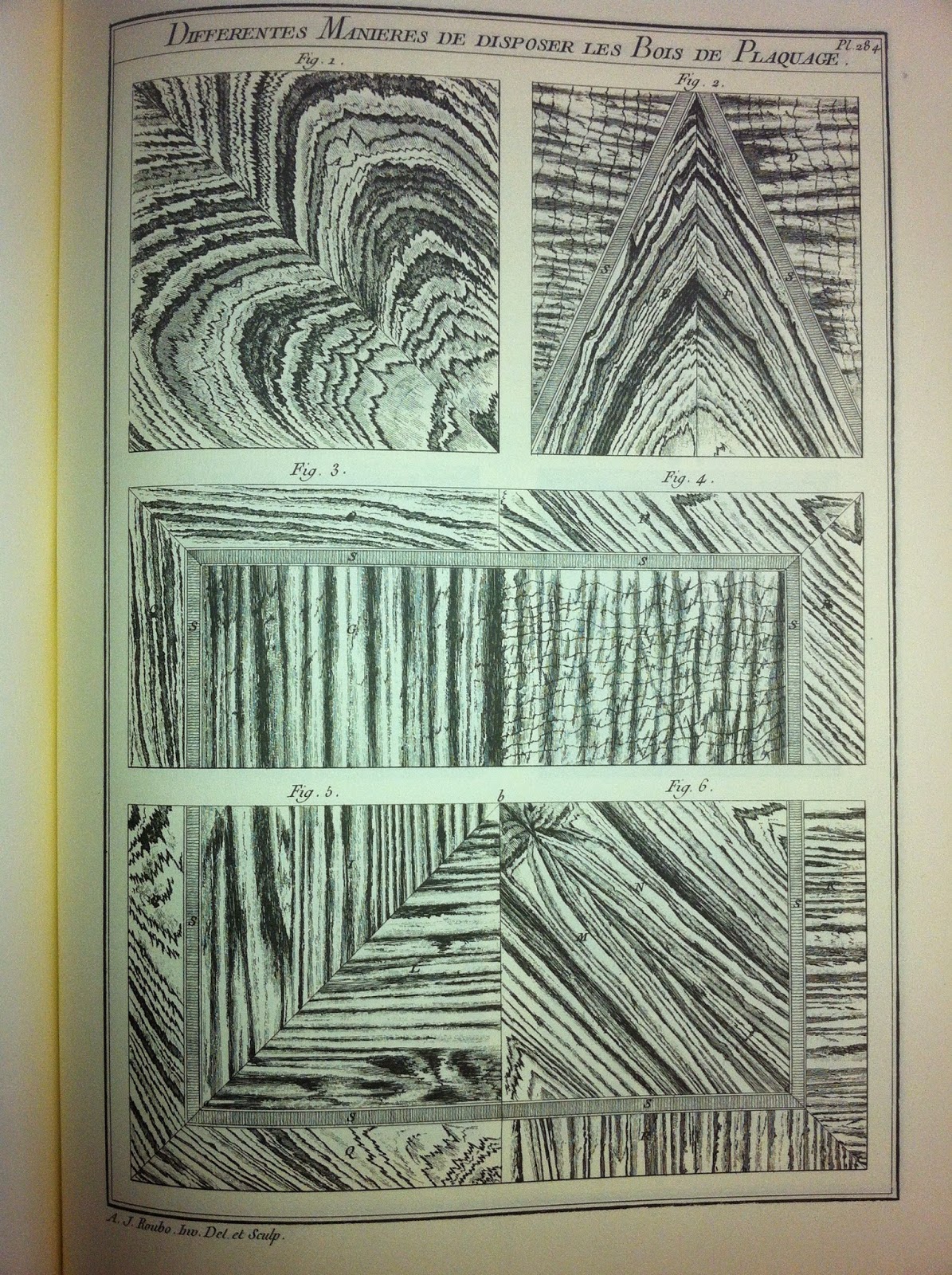
To put it simply, the worker in veneer often takes a flitch of veneer and matches it in some way to make a decorative pattern. In English these are called "book match" or "slip match" for example.
Roubo, writing in his 18th century treatise, illustrated various frisage patterns as follows:
 |
| Roubo Illustration Volume IV |
Take this Italian commode, which I recently had the pleasure to restore. The facade of the drawers have a frisage made of French walnut, and the border is a frisage of lignum vitae. The border is a good example of using the sap wood and heart wood of a dark species to create a vibrant effect.
Look at the end of the commode:
 |
| Italian Commode with Decorative Frisage |
This frisage is made by using a pattern to cut the veneer as follows:
 |
| Two Common Frisage patterns |
The pattern used on the commode is the "diamond" or "square" which is illustrated by the right example. Simply changing the direction of the grain and using the same method creates the "reverse diamond" or "cross" as shown on the left example. You will note the chalk on the left pattern. I use this to show what can be done by placing the left pattern over the right pattern and cutting through both at the same time with a homemade blade of a certain thickness, like 2mm or 3mm or larger. This will produce two results: a diamond center with a reverse diamond border, and a reverse diamond center with a diamond border. The gap left by the saw blade is then filled with an inlay strip of the appropriate width.
Using another pattern produces the butterfly pattern:
 |
| Butterfly Frisage |
One of the most fantastic (and rare) examples of frisage is found on a few pieces from the 18th century and starts with sawing the log of wood at an angle. Logs can be cut perpendicular across the end which produces "oyster" veneers. However, by sawing at an oblique angle you produce "sausage" veneers. If you have seen any of my tall case clocks, you will note I use both of these frequently.
Here is a large piece of sausage cut tulip wood veneer which is then assembled to create a wonderful frisage pattern:
 |
| Sausage cut Tulip veneer |
So, frisage relies on using the same species of wood to create a pattern. As I pointed out in the previous post, using different species and more complicated patterns creates a different term: jeux de fond. I mentioned using a simple jig to cut the elements. Here is that set up:
 |
| Simple Jig for cutting Cube elements with Material and Saw in place |
The saw is controlled to cut exactly 60 degrees. The stop is set so the the material is exactly the same length on all sides. The saw has no kerf so the cuts are fine and accurate. The material packet is composed of three different species, in a long strip, glued on the end and planed to fit exactly between the two wood strips on the jig. You push the strip (shown in the photo sideways for illustration) in the groove between the wood strips up to the stop. Then you saw the packet and remove the pieces. Repeat by sliding the strip again up to the stop and saw. With this method you can easily and accurately cut hundreds of pieces for the cube.
As I mentioned also in the previous post, you can change the wood species and get dramatic results:
 |
| Different Examples of Cube Jeux de Fond |
On the left is a cube made of the single species of ash, which creates a modern effect. Next is a cube made of oak, with a similar result. Then there is the classic cube with three different species. On the right is a cube made of tulip which has a gradual change in the wood from heart wood to sap wood, and that effect is quite different. Obviously there are unlimited choices, using the same jig.
Roubo illustrated the different patterns of jeux de fond as follows:
 |
| Roubo Jeux de Fond Volume IV |
Creating a different jig produces the "chevron" jeux de fond pattern:
 |
| "Chevron" pattern |
I should mention that these examples are some of the samples I made over 20 years ago and have managed to drag around from talk to talk. They have suffered, and at one point, actually got rained on, so they are in rough shape. I think it's time I made some new samples...
Next post will discuss the "tarsia a toppo" method.
PS: I was just "reminded" by one of my former students and a rather talented woodworker/craftsman, Aaron Radelow, that he had posted some of this material years ago. Out of respect I provide here a link to his blog post:Radelow does Jeux de fond


