Showing posts with label vector clamping. Show all posts

Saturday, March 5, 2016

It's A Gift To Be Simple

One of these days I am going to post some of the experiences I had some 30 years ago, visiting all the Shaker villages, and, at the invitation of Faith Andrews, having lunch with several of the last living Shaker sisters...those were the days!

However, as my posts tend to be lengthy and "wordy" I thought I would just post a simple thought for today.  (As the King says in the movie, "Mozart", "too many notes!)

In the past I posted my methods of vector clamping, and you can use the search box to find that.  Today I was cutting some more clamping blocks and I thought that it might be interesting to some of you, as a kind of a "Shop Tricks" feature.

I am not related to Dunn-Edwards!

Whenever I visit the paint store for stains or paint, they always hand me a bunch of stir sticks.  Even though I might actually need only one, they generously hand me a dozen or so.  My first thought was, "Hey, they are cutting down the forest to make these, so be careful how many you give out!"  But, as I approach my 7th decade on Earth, I am resigned to the fact that the majority of humans really don't think about how their actions might affect the rest of us.


Quick and Simple

So I take this handful of clean white wood sticks and cut them up at the band saw into small pieces.  This wood is nice and soft, so it makes a perfect clamping pad for any clamp.  I always keep a small box of them at the bench or wherever I do my clamping.  They last for a long time and are free.


Clamp pads in use

Another trick is to take some thicker wood and cut it into small blocks with a "V" sawn on one side.  Now, when you need to apply a clamp on the outside corner this "V" block provides a perfect clamping pad.


"V" Clamp Blocks

Just thought you would like to know.

Works Every Time

Saturday, January 4, 2014

Complex Curve Repair Simplified

Another Day Another Chair Repair
I work very hard at being humble and modest.  People who know me will laugh at that statement, but I rarely, in fact, say that I am the "best" at anything I do.  That is because I know others who are my inspiration, who are dramatically better at what they do than I am.

However, I often walk home from work thinking to myself, "I am the best chair repair man in this city."

I don't say it out loud, since, these days, other pedestrians will think I am talking to someone on the phone while I walk.  (In the past you had to be mentally unstable to walk around talking to yourself; these days it is the norm.)

Yesterday I was thinking, with a bit of satisfaction, how well this particular repair had gone.  I visualize in my mind all the elements of the repair and the way it will survive the stress of use and, if every little element of the project went well, I know I earned my pay.  Perhaps I'm obsessive.  No, to be honest, I AM obsessive!

This project was a pair of Louis XV revival 19th century armchairs which had a brass leaf gilt finish.  They had been poorly repaired over the years, including many small brad nails sunk into each of the joints and missing areas filled with epoxy filler.  Using nails to repair furniture is a crime.  First of all, it just doesn't work.  Second, it prevents the actual repair, since the joint cannot be opened easily.  Third, it requires some amount of damage to remove the nails, either by punching them out, or digging them out with tools.

All the nails do, in fact, is prevent the chair from falling apart, while at the same time allowing enough movement that the chair becomes a rocker.

One of the chairs had its crest rail broken and repaired several times.  All the wood around the mortise was damaged, and the tenon in the style was messed up.  There were several elements of the wood which were fractured and areas which were built up with epoxy.  In effect, there was nothing left structurally of the joints.

A Single Clamp Pulls Joint Together
I cleaned each of the small fragments and, over several days, rebuilt the cheeks of the mortise.  Still there was not enough wood to hold properly.  Therefore, I drilled two 3/8" holes by eye into the ends of the tenons and also into the sockets of the damaged mortises.  You need to do this carefully, since there is no mechanical way to accurately align the holes.  I put some light tack masking tape on the wood, each side of the joint, to provide at least a line of sight.  The rest is experience.

Note that the crest and back of these chairs are curved in two directions.  Therefore, this is a perfect example of using vector forces to create proper clamping cauls.  Look at the joint and visualize the single vector which bisects the surface of the joint, in the center, at 90 degrees.  That is where the clamp force needs to be applied.

Search this site for other posts on Vector Clamping.

Now take soft wood, like poplar or pine, and make wood cauls that you can clamp to the frame on each side of the joint.  These cauls need to have a fairly large surface area, so they don't slide and can be clamped securely.  Also these cauls need to have a "purchase" spot where the final clamp will grab.

Perfect Alignment

Note the two cauls on either side of the joint are held by two pony clamps each.  Then the longer single pony clamp is applied which pulls the joint together.  Finally, a second pony clamp is used to provide alignment top to bottom and a "C" clamp is used, with some plexiglass, to align the faces front to back.

The plastic allows visual inspection as all the clamps are tightened, in sequence, to pull everything together.

There is also a weight used on the front of the seat to keep this chair from falling backwards and spoiling my day.

Of course, I only use Old Brown Glue for chair repairs, since it is the best glue "in the universe" for this type of work.  I don't brag about my talents, but I do brag about my glue.

Sunday, December 29, 2013

Spring Clamps...Literally

Hand Surgery


I must have an unlimited source of clamping choices.  When you spend over 40 years repairing antiques you get creative with unique problem solving.

Most of the repairs I see come into the shop which have failed are the result of poor clamping efforts.  Face it, when the wood surfaces do not meet under precise pressure, even the best glues do not solve the problem.  A good example was the last post, where it was obvious that the person who wanted to reattach the table leg simply injected lots of plastic glue and pushed the leg back in place.  The result was a large surface of dried plastic glue which held nothing and prevented the wood joint from closing.

In that case, a simple pipe clamp would have worked, but I suspect that repair person did not have one available.
Clamps Where You Want Them

Not all cases of clamping are that obvious.  Today I needed to reattach several fingers on a carved chair.  This chair was made in Italy and had two "servants" carved at the front to hold up the arms of the chair.  I'm in no position to judge the political correctness of this subject; my job was to repair the broken hands, which had lost several elements.

As with all carving, there was no flat surfaces to clamp and the elements I needed to reattach were tiny. Fortunately, I have spent years upholstering and had a good supply of springs in the shop.  Taking these springs and cutting away loops gave me a good supply of clamps.  This is a neat trick, and I think all shops should have them available.

Available In All Sizes
I know this idea is not new.  There are spring clamps sold, with a special tool to hold them in place.  But the last time I looked, those kits were expensive and I hate to buy stuff, unless I simply have no choice.

Old springs are free, and by cutting the loops I have several sizes to choose from.  I take a file and make points on each end, so the clamp bites into the wood with the smallest mark visible after the job.  I can bend and shape these clamps to suit the job.  The important thing is that the points of the ends line up, creating a direct clamping force.  See my post again on Vector Clamping.

Add Points With File
I made some rough fingers and cleaned up the broken ends so I had a good fit.  Then I just applied a small bit of Old Brown Glue and the spring clamp.  Final result is a good amount of pressure and a repair which will allow me to finish the carving as I wish.

Simple.  Effective.  And Free.

Sunday, March 3, 2013

A Simple Vector Clamping Repair

NOT a simple Vector Clamping example


When a client presents a job, I always take the time to fully explain every detail of the work that needs to be done and then, if they want to do it themselves, they can make that decision.  Part of the reason I do that is to educate the consumer, and the other part is that I would be happy if they decide that they want to actually do it.  For whatever reason, over the many years I have repaired furniture, very few clients make that decision.  In the end, they are always happy to pay me to do it.

When it comes to gluing curved surfaces, I need to explain that it is necessary to make clamping parts which they will never see, just to hold the clamps in the right position.  Often they note the hundreds of different clamps hanging on the wall near the bench, and they conclude that it will take that many to do the job.  However, as I explain the reason I need to make these special shaped wood clamping parts, I point out that, properly done, the joint can be pulled together using only one clamp.

The "secret" is that that single clamp needs to put pressure directly perpendicular to the center axis of the joint face.  On a straight break that is simple.  On more complicated breaks there may be several different faces and all the vectors need to be considered, so several clamps will be required.

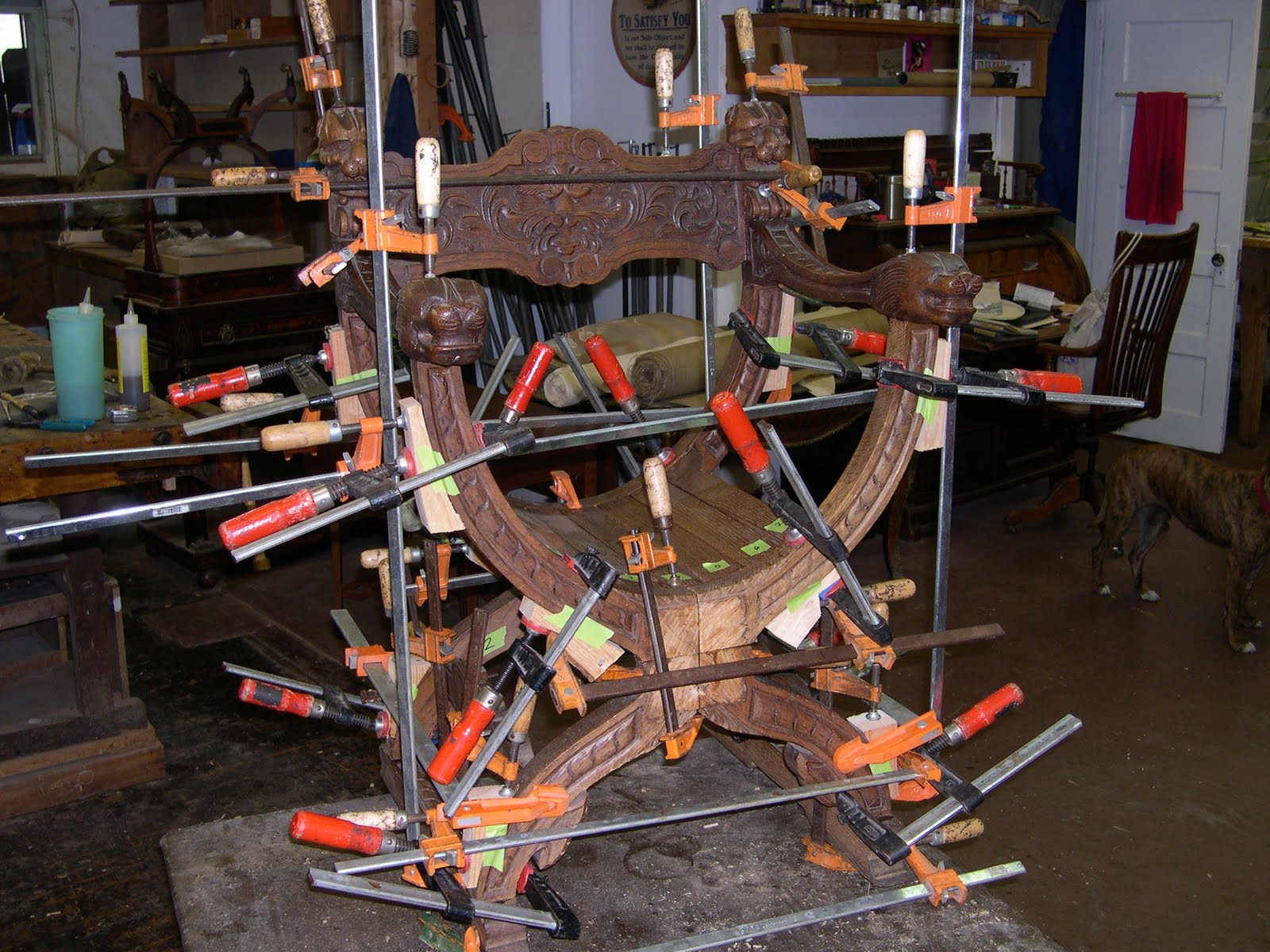
In the past I have posted photos of this type of clamping.  Recently I posted a picture of a chair for the "Why Cuban Mahogany?" post.  In these photos there are many clamps and it may be difficult to easily understand which clamps are doing what.

In this post I selected a very simple repair.  This project is a lyre shaped mirror support for a late Victorian bureau.  It is made of walnut with a face veneer.  It broke at the weak part of the grain.  The break is fairly straight and clean, and it has not previously been repaired with synthetic glue.  I think it is a clear example to illustrate the Vector Clamping procedure concept.

First I determine a line (vector) which is perpendicular to the center of the break.


Second I cut some wood clamping parts of a wood that is softer than the walnut, like pine or poplar.  These parts have "legs" which allow them to be attached to the walnut in the right position, and a "purchase" for the clamp to sit, directly in line with the vector.


Third, I use plexiglass on each side of the repair to keep the faces flush.  The plexiglass doesn't stick to the glue and allows me to see the joint as I work.  I apply warm Old Brown Glue and the long clamp which pulls the joint together perfectly.  I grin as the glue squeezes out evenly on all sides, indicating my calculations were correct.  After the joint closes, I apply a final tightening of the plexiglass clamp.


It is so easy, when you know what you are doing, that even the client could do it.

Tuesday, May 8, 2012

More Vector Clamping

I make a lot of my income from repairs. They are often quick and the simple methods I use guarantee results. I have always told customers that, if I fix it and it breaks where I fixed it, then I will repair it free. I can't recall a time in the past 43 years when I have had to fix something for free due to that guarantee.

 The reason I want to have the customer return it to me, if it breaks, is so I can learn from the failure and not repeat it in the future. Also, in the rare instance that I could not repair it properly, I don't want my work to end up in some other workshop. I value my reputation; it is all I have and it is good.

 Take chairs, for example. Nothing else comes close to making me money as broken chairs. There is no way I can even think of how many chairs I have fixed. Usually they come to me after other people have tried and failed. Therefore, I have also learned from other's mistakes. I have seen iron braces, iron rods, bolts, screws, epoxy, wire, staples, string, tape, "the strongest glue on planet Earth", and auto body filler, just to mention a few tricks, and all of them failed. At some point, the owner finds out about me and they end up on my bench. Always a challenge to undo the damage of previous repairs, which usually are worse than the original problem.

 Chairs take a beating. They are designed to be attractive, stylish and comfortable. They are not designed to support modern American bodies which are heavy and tend to force the structure in ways that it was not designed support. Add to that problem the fact that a majority of old chairs have suffered at least one repair in their life and you understand why I have so much work.

 Last week I was searching on the internet for Ming dynasty chairs, and I found a story about a visitor to a museum in China who felt tired and decided to sit down in a Ming chair which was on a pedestal behind a barrier rope. He broke the chair in three places, fortunately all places where there had been previous breaks. Like I said, antique chairs were not designed for the modern man. I think Frank Lloyd Wright had a point when he designed chairs so uncomfortable that no one wanted to sit in them.

 In any event, I repair chairs practically every day I work. Here are a few simple rules which I follow that make it pleasant. First of all, try to remove all other repairs. This means that, in the case where you have severely fractured wood, and lots of small fragments, you must do the repair over several days. Each day you glue two or three fragments together to form a larger piece. The next day this piece is glued to another, and so on, until you have a two large elements to assemble properly. Most workers try to put all the little pieces together at one time and it makes a mess, as they move around under clamping and the glue gets into the voids.

 Another rule is that it is always necessary to remove all traces of dirt and glue from the wood surface. Usually, with synthetic glues, this requires scraping and using a chisel to carefully remove the glue from the wood, without removing any wood. I prefer to use a toothing plane iron to scrape away, with the grain, the glue and dirt. You can use a small section of a hack saw blade (with larger teeth) to do the same thing, if you cannot find a toothing plane iron. Remember, you cannot glue dirt and expect it to work. Always consider the surface area of the wood in the repair to calculate the potential success of the job.

 End grain surfaces don't count. Long grain surfaces are the only areas where glue holds, and experience will tell you if there is sufficient surface area inside the joint to hold the stress. If not, you may need to add wood to the repair to make it work, either with an internal tenon or external "blister patch". Always use the most conservative repair that you can to protect the value of the object.

 I do not need to stress that the only glue to use is animal protein glue. Any reader of this blog knows where I stand on this question. As I've said for years, "I will use a synthetic glue only if it can be shown that my preferred animal glue won't work and the synthetic glue is better." Never gonna happen.

 The final advice is to understand vector forces when you apply your clamps. Most people do not have enough clamps or the proper variety of clamps to do the job professionally. I have many hundreds of clamps, of every imaginable type. I also have a large box of wood scraps to fit most common furniture shapes. You cannot clamp on curves or complex surfaces without adding wood blocks to provide a purchase for the clamps. The essential rule of vector clamping is that the primary clamp, which actually pulls the joint together, provides its force directly perpendicular to the center of the joint. With curves that means the clamp needs to be out in space, somewhere away from the actual furniture. Therefore, you need to provide a piece of wood shaped to fit the furniture, with a spot on that scrap of wood to hold the primary clamp in its proper position.

 I use a soft wood, like pine or tulip, so as to not damage the antique surface. I cut it to fit the shape of the curve. I provide enough surface area for the scrap to not slip and clamp it firmly to the chair part, before I use any glue. I use scraps of cork under the clamp blocks to protect the surface. I make a dry run after all the scraps are attached to see that it works properly. Then and only then do I reach for the glue.

 Old Brown Glue gives me the additional working time I need to assemble complicated repairs, and has amazing holding power. I apply the glue and then the primary clamp. If I have done my job properly, then I am rewarded with a nice bead of glue evenly squeezing out under pressure as I tighten the primary clamp. No slipping, no change in alignment, no panic. Just success.


 I am rewarded with a happy customer who can use his antique chair, and a quick paycheck. When i make $100 for a 15 minute repair, I am reminded that the 15 minutes took 43 years to learn.

Monday, October 24, 2011

Simple Example of Vector Clamping


I was just looking at the photos I posted of the chair with all the clamps. Unless you go through a sequence of applying the clamps it is difficult to fully understand why each clamp is placed where it is. After dozens of clamps are in place it just looks like a mess.

I may be accused of using more clamps then necessary in my repairs. That may be simply because I have collected more clamps then a single person should have over the years. However, it is also because I study each repair carefully to fully understand where all the forces need to be applied.

If the part is shattered or previously repaired badly, it is necessary to take apart all the fragments and clean the glue off of each using small chisels or a small toothing plane iron I keep for that job. I use an Optivisor to see more closely what I am doing and I am extremely careful to not remove any wood.

Then it is important to begin the repair by gluing several small parts together, wait overnight, and continue adding fragments day by day until the repair is complete. Sometimes with chairs I have more than a dozen fragments to assemble just for one joint.

In other cases, the repair is simple and easy. Just remove the modern glue, clean up the wood surface and add protein glue.

In the case of this American Empire center table, pictured above, the two rear legs had come loose. Since the top of this table is marble, there was a lot of force on the joint, which was originally held by three dowels. The owner had had some person try to glue it with the "strongest glue on planet Earth" with horrible results. Part of his problem was the glue and part of the problem was the failure to understand clamping pressure on this joint.

Note the central axis of the joint, perpendicular to the face of the plinth, extends above the toe of the foot, out in space. There is no way to put a clamp there, unless you add a block. That illustrates very clearly what I intend to show about vector clamping. Just by adding a pine block of wood on the foot I was able to create a purchase for the primary clamp. The red clamp is the primary clamp. Since gravity also creates a force downward on the clamp in this position, I added a second, orange, clamp to compensate. These two clamps are all that are required to achieve a correct vector force on the face of the joint.

The entire operation took 15 minutes and made me a profit and the owner of the table happy. I have always guaranteed my repairs for life. Sometimes the project will return for more repair but never in the place where I repaired it. I can say, with some satisfaction, that I have never had a repair failure in my career of restoring antiques. Do it right and forget it.

Sunday, October 9, 2011

Vector Clamping


Question: Can you have too many clamps?

I think you know the answer...

A lot of woodworkers like to read books, magazines and posts about their craft. There are literally hundreds of authors who discuss dovetail drawers, finishing methods, the best tools, etc. I am no different. I have bought books that I was sure would be poorly written and contain misleading information just so I could read them and be proven right. I have many old and out of print books which also were essential for my career. I not only have all the magazines, but I have the promo leaflet for FineWoodworking which was sent out before the first issue.

In all this material, there is one aspect of furniture which is difficult to address: proper clamping methods. Sure, there are stories on vacuum bags, some on veneer presses, a few on specific clamping issues, and so on, but so far I have not seen an article which clearly addresses what I call "vector clamping."

I am sure that my mathematics, geometry and "proper" education in those fields lets me think differently about clamping, but at the same time it is said: "If you scratch the surface of a woodworker, you will find an engineer." This statement was proven at the first SAPFM dinner so many years ago. I found myself sitting at one of the tables in the front with Underhill, Breed, and a dozen other veterans, in a room with about 200 members. The speaker asked the group, "How many of you are making a living at traditional woodworking?" Most of those sitting at my table raised their hands, in total about 10% of the group. Then the speaker asked, "How many of you are engineers?" It was a clear majority.

So I assume that, when I use the term "vector," many woodworkers will know what I mean. A vector is a little arrow which shows the direction of the force under consideration. So a clamp applies pressure in a direction perpendicular to the face of the clamp. Of course, this pressure is not constrained in a single linear vector, but forms a cone of force as it leaves the surface of the clamp. As an example, my veneer press screws exert pressure over 81 square inches, or a 9x9" area, and I placed them on the press 9" apart to form a grid.

The primary purpose of discussing vector clamping is to illustrate how I restore antiques, which very often have curved surfaces. Tripod tables, cabriole legs, bent wood windsors, and many, many traditional forms of furniture rely on curved elements, which often break. These breaks can occur at a joint, like the leg on a tripod table, or in the grain of the wood, like the foot breaking off of a cabriole leg.

In many cases these breaks are treated in a way which makes my life miserable. The repairman will take some synthetic glue, epoxy or "the strongest glue on planet earth" and paint it on the break, then frantically search for a way to clamp it before the glue sets. The result is a mess, and I am constantly trying to undo the damage, scraping off the glue and starting over.

I usually will tell the client: "If you had not had it repaired before, I could do it for half the cost."

Assuming you have a fresh break with good wood surfaces, the first thing you need to do is determine the center of the break or joint, and imagine a vector line perpendicular to that point in space. (Editor's note: see comments below)  If you are able to put pressure with a single clamp on that vector line, it will clamp the repair properly. That is all there is to it.

Now, it is often the case that the vector line which pushes directly perpendicular to the center of the break goes off into air, away from the wood surface. Like the curved leg on a pedestal table, the line goes off the curved top edge of the leg, and a clamp will not gain a purchase there. That is why you need to create a proper place for the clamp to press.

Select a softer wood than the object, like pine, poplar or other wood. Shape the wood to exactly fit the surface of the curve, and leave a length of wood for another clamp to hold it in place. Clamp this new piece in position and locate the vector line on it. Draw a perpendicular line on the new piece which crosses the vector line at 90 degrees and cut to this line with a saw or chisel. This will be the place to put your clamp for the repair.

In every place where you need it to press directly on the vector line for the repair, you will need to cut a softer piece of wood and clamp it in place. Do this before you reach for the glue. Now your repair has little pieces of soft wood clamped all over it in places where you need to make the repairs. Grab your glue and put it on the repair, place the pieces in position and use a single clamp to press the vector line together.

It is rewarding to see a single clamp pull a complicated joint together, without slipping to one side or another. When done, all the soft wood pieces can be kept in a box for reuse in similar jobs which will certainly happen.

I do not need to stress that you use animal protein glues...