Showing posts with label Roubo. Show all posts

Saturday, September 20, 2014

Exciting WIA Week in Winston Salem


Fortunately, I had decided to arrive several days in advance of the WIA conference and stay a few days after, so Kristen and I were able to spend some quality time in old Winston Salem.  In fact, the last time I visited Winston Salem and MESDA was in 1978, during one of my several trips to visit East coast museums and historic settlements.  I am sorry it took so long for me to return.

The weather was great, in fact, with only a slight spot of rain and moderate heat.  While I was away, on the other hand, San Diego had a heat wave, with several days above 100 degrees.  Poor Patrice had to work at the bench, building the top of our Treasure Box (Series 2) while I got to wander around from place to place, thinking perhaps I should have packed a sweater.

Last year, during this time, I was teaching at Marc Adams school, and only had a short time late on Saturday to get away.  I broke several speed limits driving from the school to Cincinnati to see the WIA event.  I got there about 30 minutes before it closed, with just enough time to get my signed copies of Roubo from Chris.  As it turned out, I also had to sign a few copies, since I wrote the Forward.  The best part was that I got to have a nice dinner with Roy later that evening.

This year, I was a speaker, and presented two lectures to a rather enthusiastic and supportive audience.  The first was a talk on "Historic Marquetry Procedures,"and went through basically 500 years of the traditional methods used to create this art form.  The second was "Building and Using a Chevalet."  At the start of this lecture, I mentioned that I have been working for nearly 20 years to introduce this unique tool to woodworkers in North America.  Then I foolishly asked if anyone in the audience knew about this tool.  When nobody raised their hand, a person in the back shouted, "You haven't been very successful!"  As they always say in law school, "Never ask a question if you don't already know the answer."

I shared the lecture room with Roy Underhill, which is always an experience.  As I was setting up my talk, he was putting his things away.  They had scheduled a half hour break between speakers.  Just about the time I was ready to start, Roy had the brilliant idea to "introduce" me. You probably already know he can be theatrical, to say the least.

He said the first time we met was at the Great Salt Lake, and there was a stampede of brine shrimp.  Tim Webster was sitting in the audience, and had the quick thinking to pull out his camera and video it, posting it on YouTube soon after.  I was speechless and had to hold my tongue, while he went on and on, creating a story that was more and more amazing.  My mike was turned up to the max and when I did comment it was way too loud.  Near the end I asked him to turn down the mike, and he crawled under the screen to adjust the volume.  I thought I had a quick wit, but there is no way I can keep up with Roy when he is "on."

Here is the video: Underhill introducing Edwards

While I was having fun in the lecture hall, Kristen was in the Trade Show, where we had a booth for both the ASFM school and OBG.  She is a master of working these shows, and I am very grateful for her talent, as I usually lose my voice and patience trying to compete with the noise.

Of course, Roy had to stop by and pick up some glue...


At the end of the show, they gave away a rather expensive band saw.  I wondered if it would fit in the overhead compartment on the plane, but fortunately I was not in the contest to win it.  However, they asked all the speakers at the show to sign it.  I asked, rather incredulously, if they really want me to sign a power tool?  They insisted, so I did.  You can see my name, with the comment added 
"Use hand tools."


After the show Kristen and I went to MESDA where we had a nice tour with Daniel Ackerman.  We also enjoyed a private home tour by Tom Sears, both of which are members of SAPFM.  We had dinner with Jerome Bias, who is the joiner at Old Salem, and then visited him at work, where he demonstrated his Roubo veneer saw.


Across the hall Brian Coe was using the foot power lathe to make some turnings.  That is a rather impressive tool, made from massive pieces of oak.


All of this activity was in the Brothers House, and it was full of woodworkers from the show, having a great time sharing stories.  There was a warm sense of camaraderie and mutual friendship.


I made a promise to myself not to wait another 30 years before returning to Winston Salem.  Thanks to Megan, Don, Roy, Jerome, Daniel, Phil, Freddy, Martin, Tom, Brian, Will, and too many others to name.  You know who you are!

Wednesday, August 13, 2014

Tarsia Geometrica Part II


Italian Commode


To continue the explanation of Tarsia Geometrica and its various forms from the previous post, I would like to return to the term "frisage."  Obviously this term is French and not much used in American woodworking shops.  However, it is really well known under different terms in our language.

To put it simply, the worker in veneer often takes a flitch of veneer and matches it in some way to make a decorative pattern.  In English these are called "book match" or "slip match" for example.

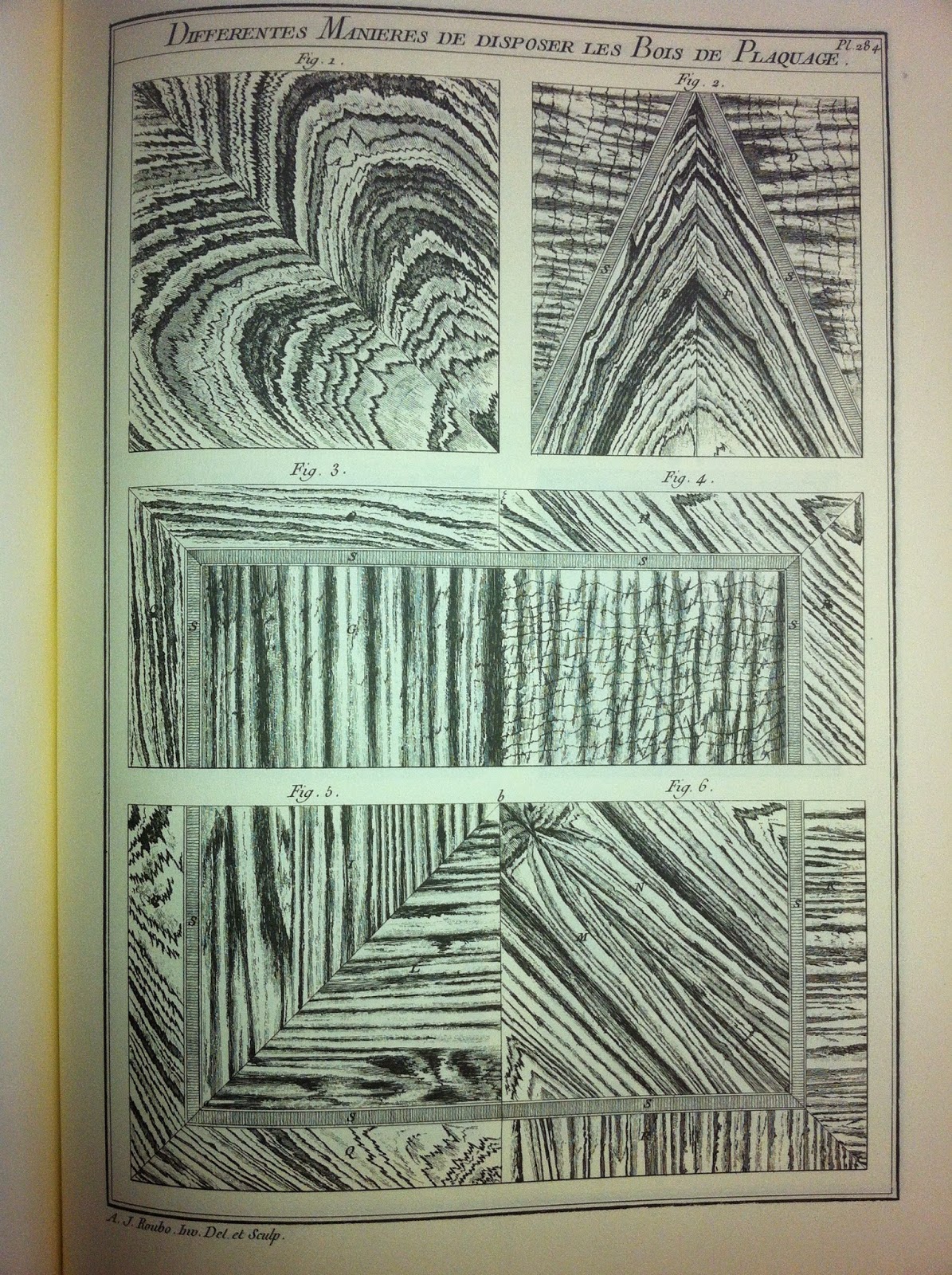
Roubo, writing in his 18th century treatise, illustrated various frisage patterns as follows:


Roubo Illustration Volume IV


Take this Italian commode, which I recently had the pleasure to restore.  The facade of the drawers have a frisage made of French walnut, and the border is a frisage of lignum vitae.  The border is a good example of using the sap wood and heart wood of a dark species to create a vibrant effect.

Look at the end of the commode:

Italian Commode with Decorative Frisage

This frisage is made by using a pattern to cut the veneer as follows:

Two Common Frisage patterns

The pattern used on the commode is the "diamond" or "square" which is illustrated by the right example. Simply changing the direction of the grain and using the same method creates the "reverse diamond" or "cross" as shown on the left example. You will note the chalk on the left pattern.  I use this to show what can be done by placing the left pattern over the right pattern and cutting through both at the same time with a homemade blade of a certain thickness, like 2mm or 3mm or larger.  This will produce two results:  a diamond center with a reverse diamond border, and a reverse diamond center with a diamond border.  The gap left by the saw blade is then filled with an inlay strip of the appropriate width.

Using another pattern produces the butterfly pattern:

Butterfly Frisage

One of the most fantastic (and rare) examples of frisage is found on a few pieces from the 18th century and starts with sawing the log of wood at an angle.  Logs can be cut perpendicular across the end which produces "oyster" veneers.  However, by sawing at an oblique angle you produce "sausage" veneers.  If you have seen any of my tall case clocks, you will note I use both of these frequently.

Here is a large piece of sausage cut tulip wood veneer which is then assembled to create a wonderful frisage pattern:

Sausage cut Tulip veneer

So, frisage relies on using the same species of wood to create a pattern.  As I pointed out in the previous post, using different species and more complicated patterns creates a different term: jeux de fond.  I mentioned using a simple jig to cut the elements. Here is that set up:

Simple Jig for cutting Cube elements with Material and Saw in place

The saw is controlled to cut exactly 60 degrees.  The stop is set so the the material is exactly the same length on all sides.  The saw has no kerf so the cuts are fine and accurate.  The material packet is composed of three different species, in a long strip, glued on the end and planed to fit exactly between the two wood strips on the jig.  You push the strip (shown in the photo sideways for illustration) in the groove between the wood strips up to the stop.  Then you saw the packet and remove the pieces.  Repeat by sliding the strip again up to the stop and saw.  With this method you can easily and accurately cut hundreds of pieces for the cube.

As I mentioned also in the previous post, you can change the wood species and get dramatic results:

Different Examples of Cube Jeux de Fond

On the left is a cube made of the single species of ash, which creates a modern effect.  Next is a cube made of oak, with a similar result.  Then there is the classic cube with three different species.  On the right is a cube made of tulip which has a gradual change in the wood from heart wood to sap wood, and that effect is quite different.  Obviously there are unlimited choices, using the same jig.

Roubo illustrated the different patterns of jeux de fond as follows:

Roubo Jeux de Fond Volume IV


Creating a different jig produces the "chevron" jeux de fond pattern:

"Chevron" pattern

I should mention that these examples are some of the samples I made over 20 years ago and have managed to drag around from talk to talk.  They have suffered, and at one point, actually got rained on, so they are in rough shape.  I think it's time I made some new samples...

Next post will discuss the "tarsia a toppo" method.

PS:  I was just "reminded" by one of my former students and a rather talented woodworker/craftsman, Aaron Radelow, that he had posted some of this material years ago. Out of respect I provide here a link to his blog post:Radelow does Jeux de fond

Tuesday, August 12, 2014

Tarsia Geometrica Part I

English Jeux de Fond Coffer
I remember clearly the first time I was in France and visiting an atelier where several ebenistes were working.  Looking at their work, I noticed some of the marquetry was very geometric.  In my efforts to impress them, I used the term "parquetry."  They looked at each other with obvious blank expressions, and then looked at me as if I had just fallen off the turnip truck.

"C'est du placage, pas du parquet. Nous ne sommes pas menuisiers, nous sommes ébénistes."

(Translation:  "That's veneer, not flooring.  We are not 'menuisiers', we are 'ebenistes'."  In point of fact the former works in solid wood, and the latter uses veneer.)  It turns out that it is common for English speaking woodworkers to confuse the term for geometric marquetry with the profession of laying solid wood flooring.

They were helping me to understand that using the English/British term "parquetry" is not correct when  discussing a form of marquetry generally known as "frisage" and in particular "tarsia geometrica."  Another term for a version of this type of decoration is "jeux de fond."  Pierre Ramond's book discusses these terms in great detail, but there is general confusion about what they mean exactly.

Simply put, the overall term for the process of making this work is "tarsia geometrica."  This term includes other specific terms for different patterns which all use repetitive patterns in wood to achieve a decorative surface.

"Frisage" is used to describe simple book matching of slip matching of larger veneer surfaces, usually to create a background.  Normally, frisage work involves using the same species of wood in a way that creates a pattern.

"Jeux de fond" is also referred to historically as mosaic work, as it involves much more complicated patterns of shaped elements, usually with different species of woods.  In many cases it creates a 3-D effect.  The most well known pattern is the cube, made up of three different pieces, each a different color density.  This pattern is also found in quilting and tile work.

Recently, I had the opportunity to restore several excellent examples of tarsia geometrica.  One was an Italian commode, made late in the 18th century.  The other was an English coffer, made early in the 19th century.  Each one needed extensive work in re gluing the marquetry and re polishing but in the end they looked magnificent.

I will discuss the commode in the next post, as it included a technique known as "tarsia a toppo" and I want to clarify why that is different, even though the final results are similar.

I want to start with the simple cube design:


Cube Design on Assembly Board

This is a rather common design and forms the basis for what follows in this discussion.  The cube is made of three elements, each one identical to the other in shape and size, but different in species.  By changing the wood species and grain direction of each piece, you can vary the effect.  I use a simple plywood cutting board, with a 60 degree slot for my back saw, which has little or no set to the teeth.

I will explain more about the cutting jig soon, but today I just want to discuss how this motif is used in a complicated jeux de fond pattern.  To illustrate further, consider if the cube elements were cut in one size and then also cut twice as long and combined.  This would be the result:


Large Cubes with Small Cube

Now if you take the same design and turn it 180 degrees it changes:


Large Cubes with missing Small Cube

This effect is an optical illusion that the brain automatically understands.  Since light naturally comes from above, the brain computes the top of some form as being lighter.  When the design is rotated 180 degrees the brain understands it as a completely different image.

I thought I would make a sample panel which incorporated both of these designs with a common joint in the center:

Compare Left side and Right side


Another experiment I tried was to make a three dimensional grid:


Experimental Grid design on Assembly board
There are lots of ways you can develop different designs with this idea.  The English coffer at the top of the post uses the cube in a very imaginative way.  There is a lighter grid floating in front of a darker grid, which in itself forms a cube space.  To add to that, there are three smaller cubes at the intersection.
It is a wonderful pattern:


How Many Cubes?
So, during restoration, I took the time to trace this pattern for future projects:


Tracing with Wood Species and Grain Direction
I began to wonder where this amazing pattern originated, so I picked up my copy of Roubo and started looking at the illustrations.  When in doubt, always start with the source reference material.  To my amazement, I found the direct source in Volume IV.  Here is the original Roubo design and after that my tracing of the pattern, showing it to be simply a repetition of the Roubo motif:


Roubo Volume IV


English Coffer derived directly from Roubl


Here is the top of the coffer with the nautical compass in the center:

Coopered oak top with jeux de fond marquetry

Next post will continue this analysis and compare with similar marquetry decoration.

Sunday, November 10, 2013

Mr. Roubo at Ecole Boulle

Mr. Roubo's Book
From time to time I find myself actually reading posts from my own blog.  Some times I am impressed with what I wrote and often I realize I left something important out or what I was trying to say was not as clear as I would like.

Today I put down my English copy of Roubo, which I have read twice, and went back to the computer to read my last post.  That was when I remembered my early conversations with Christopher Schwartz about writing the Preface to the new edition.  My post on "Roubo Redux" left out one of the most important events in my life as it related to Mr. Roubo.  So I went back to my email conversation and pulled up these photos to share.

I Love Libraries
As I spent several years at ecole Boulle as a student, it was my pleasure to explore the school and meet other professors and their workshops.  At some point, I opened a door and found myself in a library.  What a pleasant surprise!  It somehow had not occurred to me that ecole Boulle would have a library, but as soon as I discovered its existence I began to spend a lot of time searching its stacks.  It was full of some amazing books, mostly in French, but still exciting.

Title Page with Inscription
The first book I asked for was Roubo.  The librarian smiled and returned with an original first edition of the same.  I carefully placed it on the table and opened the cover.  I still remember, as I sat quietly in the center of the library, with the sunlight raking across the desk from the 19th century windows,  how I stopped breathing when I saw the inscription.

"A Camille Pouplin affectueux souvenir de la petite fille de Roubo.  Adele Margolle"

Handwritten in ink was the dedication: "To Camille Poupin friendly souvenir from the grand daughter of Roubo. Adele Margolle."
Roubo's Grand Daughter's hand

Not only was this particular copy of Roubo's work directly from the family but it is entirely possible that it was a copy that Mr. Roubo himself owned!  I imagined his hands turning the pages exactly as I was doing.  It struck me that I was sitting in a French school, named after the greatest cabinetmaker of France, reading a book written by one of the most famous authors of the trade.

It just doesn't get any more real than that.

How could I have not included this little story in my post?


Wednesday, October 23, 2013

Roubo Redux

Patrice and Agnes Reading Roubo in French
I first met Mr. Roubo at the Getty Museum Conservation Lab around 1975 or so.  There was a French conservator there who had a copy and used it for his reference.  I was interested in it, since it was full of amazing drawings of various tools and woodworking methods I had never seen before.  As I did not speak or read French, I began asking him questions hoping he would translate.

His response was rather cold.  He seemed to think that it was only possible to understand the mysteries of Roubo by understanding both the French language of the 18th century and the specific French history of the woodworking methods shown.

I was left with a feeling of frustration, knowing that a book of knowledge about a trade I cared very much about was not accessible to me.

20 years later, when I was attending school in Paris, I would divide my spending money between veneers at Patrick George and books at the Librairie d'Ameublement, which specialized in books about woodworking and the trades.  I bought books in French, German, Italian and English, and my bags were always at the limit.  Of course, Air France back then allowed me two checked bags (30kg each) and a carry on (no weight limit!).  And they provided a great meal inflight.  Those were the days...

Anyway, each time I returned to Paris, I would rush over to the bookstore and ask what was new.  The owner remembered me and my tastes, and would direct me to exactly the books I needed.  In one section of the store was the Roubo, which was very large and very expensive.  And in French.

Each visit, I would ask the same question:  "When will it be available in English?"  Always the same answer, "Probably never, since there is no demand for it by English speaking people."

I eventually was able to acquire a wonderful full size edition (in French) which was printed in 1975.  That date is ironic, since it was the same time I first heard of Roubo.  However, I only received this edition, which included all four volumes, just last year.  My partner, Patrice, was much more helpful in translating the work, and my understanding of French has improved over the years.

Nearly 20 years after I finished my studies in Paris a team lead by Don Williams and Christopher Schwartz managed to complete the project.  Last Saturday, after I finished teaching a class in French Polishing at MASW, I got into my car and drove (at a high rate of speed) down 74 from Indianapolis to Cincinnati.  I was in a rush to get to the last hours of the Woodworking In America trade show to visit Christopher and Don, as well as many other friends and professionals in the wood industry.

I was also there to pick up my copy of Roubo in English.  For the first time in over two centuries people who don't read French can now enjoy the wonderful insight and information which Roubo captured in this important work.  Lost Art Press had printed a limited edition of large format books which sold out immediately and will not be reprinted.  However, for the rest of us, where the book may end up on the workbench as a "working" copy, Chris has printed a smaller hardcover edition.

That edition is very reasonably priced and available here:  Lost Art Press: Roubo

You cannot imagine my excitement to finally be able to read, in English, the information which had so long eluded me.  Chris and Don and the team deserve the MacArthur award for genius for their efforts.

I was also honored to be able to contribute the Preface to this historic edition, along with my friend and business partner, Patrice Lejeune.

Life is full of amazing surprises!

Wednesday, February 27, 2013

The History of the Chevalet de Marqueterie

When I started restoring marquetry on antique furniture in 1969, I looked at Diderot and Roubo for information on what kind of tool the French were using.  What I found was called a donkey, and it had a seat, a foot pedal and jaws for holding the veneers in a packet.   At that time I was traveling each month to the midwest to buy antiques for resale.  During one trip I found a harness maker's bench, which looked exactly like the donkey illustration in Roubo.  The only difference was the jaws were perpendicular to the worker, not parallel.  I paid $150 and brought it home, took it apart, made a new seat and remounted the jaws to work for veneer.  I spent nearly 10 years riding that donkey, with a hand held fret saw, struggling to create marquetry like I saw on 18th century furniture in museums.

I have posted previously here about how and when I first saw a real chevalet.  I call that discovery "pre industrial espionage" in my lectures.  In short, when I saw the saw frame support, I immediately understood how important that part of the tool was to keep the blade perpendicular to the work.  I built that tool, which is called a chevalet, and used it for nearly 15 years before I was accepted at ecole Boulle.

When I asked Pierre Ramond about the history of the tool, his response was not precise, either because of my poor understanding of French at that time, or because the actual facts of the development of the tool are "secret."  One thing is certain: the knowledge and use of this tool is not wide spread, and seems to be limited to workers in Paris and those who learned the trade there.

I am fortunate today to have the internet and a partner, Patrice Lejeune, who is really a talented researcher, among other things.  His wife, Agnes, shares this talent, and has just received her PhD in Art History from the Sorbonne, in Paris.  Patrice was able to search through early French books online and found some important facts about this tool.

The only reference I have found to the chevalet in English publications is in the book, "The Gentle Art of Faking Furniture," by Herbert Cescinsky.  He was a noted furniture historian, and published this work in 1931, with a second edition published in 1969.  I treasure this book, and many others which I have collected on the subject of fakes, not only for its unique first hand perspective on the trade, but also since it includes photos and information about French marquetry.

On page 89, he states: "The marqueterie-cutter's saw, in its guides, with the 'chops,' which open and close by foot pressure, to hold the veneers while being cut, and his seat at the end (the 'donkey,' as it is called), have hardly varied at all in two hundred and fifty years."  If you believe this statement, then the tool was used as early as 1680, suggesting that Mr. Boulle and Mr. Gole and all the rest of the late 17th century ebenistes could have used it.

Here I need to make an important distinction.  Roubo, writing in 1769, illustrates an "Ane" in his famous "L'Art Du Menuisier," Volume IV, Plate 291 and 292.  This illustration shows a tool without the saw frame support, and the translation of the noun, "ane," is "donkey."  When the tool is shown with the additional saw support, it is called a "chevalet."  We are talking about two different tools, which do the same job, and are often called the same name, incorrectly.

The term "chevalet" is interesting by itself.  Pierre Ramond specifically asked me to find a better translation for the tool than "donkey" when he retired from teaching.  I looked up the term "chevalet" in a French dictionary, and found the answer.  "Chevalet" is a "stand, support, trestle, frame.  "Chevalet de scieur" is a sawbench, sawhorse.  "Chevalet de peintre" is an easel.  All of these terms have a common function: something to hold the work in place while it is being worked on.


Patrice made an important and significant discovery during this search for the origin of the tool.  He found a book online, "Des Principes de l'Architecture, de la Sculpture, de la Peinture, et des Autres Arts qui en Dependent.  Aved un Dictionnaire des Termes propres a chacun de ces Arts."   This book was published in Paris by Jean-Baptiste Coignard, in 1676, and reprinted in 1690.  The first edition published in 1676 has a full page illustration in Volume III, page 457, that shows clearly two important things: a two man veneer saw and the wood clamp holding the veneer log, which rises from a hole in the floor, and a pair of "anes" or "donkeys" with slight differences.  These donkeys each have a foot operated clamp, and are shown holding the packets of veneer in the jaws.  There is a tray to catch the parts, and the "bocfil" or fretsaw is resting on the floor.

This proves conclusively that the donkey existed during the time of Boulle and Louis XIV, and that the illustration in Roubo, some 70 years later is essentially the same tool.

What I am now researching is the precise time when the saw frame arm was added to this tool.  Clearly, the size and complexity of marquetry which was produced during the third quarter of the 18th century would suggest this tool was used, but I haven't yet found the "smoking gun."  It is evident that the "chevalet" with the arm existed during the 19th century, and I have many references for that.  I will post any new discoveries on this site as soon as they appear.

At the same time, you will note in the above illustration that the tool is referred to simply as "appareil special pour decouper la marqueterie."  Translated that means "apparatus (or tool) special for cutting marquetry."  This is from a catalogue of tools for sale by La Forge Royale, published during the first decades of the 20th century.  It is interesting they did not use the term "chevalet" so I wonder when that term became associated with the tool.

The donkey and chevalet were not the only tools used to make marquetry of course.  In addition to the hand held fretsaw, there was a foot operated frame saw, like I used in making the AIC video.  I was trying to be conservative in deciding to use that saw, instead of the chevalet.  One reason I suspect that Boulle would have also used that saw is the sheer weight of the packet when using brass, pewter and shell, as Boulle did.  It is very hard to hold it in a vertical position without breaking blades, as would be required if it were cut on a donkey.  Therefore, I suspect that these large and heavy packets were cut on a table, horizontal, using a foot powered frame saw with a vertical blade.

It is interesting when you view all three videos on the last post (The Art Institute of Chicago Project) to see each of us using different tools.  I am cutting with a foot powered frame saw, Patrice is using a hand held fret saw, and Yannick is using a chevalet.  I suspect that workers in the period used a wide range of methods to achieve the amazing results we see in museums today.  The great tragedy of that time is that Mr. Boulle's workshop burned to the ground at the end of his career, and all the work, tools, materials and designs were lost forever.  It is left to the historians to speculate and the researchers to discover the secrets of the past.

POSTSCRIPT:  I just received an email from Filip in Belgium adding confirmation to my decision to demonstrate the Boulle method using the foot powered frame saw instead of the chevalet.  I haven't had the money yet to purchase Pierre Ramond's latest book, "Andre-Charles Boulle, ebeniste, ciseleur et marqueteur ordinaire du Roy," published by Vial in 2010.  However, my friend Filip has a copy and sent me images from page 24 and 25 where Pierre concludes that Boulle used a foot saw.  Here is the image with the text:


Those of you who read French will note that on both illustrations Pierre concludes that Boulle probably used a tool like this.  We had made this decision based on the size and weight of the packets that were cut, and the technology available at that time.  It is always rewarding to have my independent research supported by my professor, and the person I believe knows more about French marquetry than anyone else alive.


Thursday, October 18, 2012

Chevalet Anatomy Lesson

I am encouraged that more and more American woodworkers are interested in a weird, highly specialized veneer cutting tool that the French developed during the 18th century and perfected in the 19th century and managed to keep relatively secret over all those years.

I give credit to Dr. Pierre Ramond, who was the first to publish plans and explain what this tool did in his ground breaking book, "Marquetry," printed in English by Taunton Press in 1989.  Even though there was a French edition of this book published in Europe years before, it was the Taunton Press edition which first hit the American market big time.  This edition is now out of print, and the Getty Press reissued the same volume with a new cover and some added photographs in 2000, and that edition is now also out of print.  Fortunately, we have the internet and book search engines.

I began making and selling hardware kits and blueprints for a chevalet when I opened my school, the American School of French Marquetry, in that same year, 2000.  Many of my students purchased kits and went on to build their own tools, and those tools have encouraged other woodworkers to build their own versions.  As this tool gains acceptance in the marquetry world (admittedly a small world), I get calls and emails asking about how the tool works and to explain certain features of the tool or explain some obscure detail of its operation.

The initial problem is that it is usually the case that the builder has never used this tool and won't realize what parts of the build are important until he uses it.  I did this on my first tool, which I built in the 1970's.  After spending time in ecole Boulle and learning more about it, I modified that first chevalet several times.  It had so many changes that, today as it sits in my school, it is named "Frankenstein."  (By the way, Frankenstein swings both ways, right and left handed!)

The biggest problem I have in discussing this tool with someone is terminology.  What are the parts named?  In Pierre's book, the cut list for the plans include generic English translations of the names, which are sometimes confusing.  Therefore, I propose to create some terms here for common usage, so that when others ask me I know what they are referring to.


There is really no problem with the names of the lower half of the tool.  You can see the seat, which has a front and back leg, as well as a foot pedal.  There is also a lower stretcher and a large foot or base which stabilizes the structure.  Mounted on the seat, in front of the worker, is the vertical column, which supports the pressure arm.  This pressure arm is connected by a chain to the foot pedal which moves up and down and clamps the vise on the packet.  Note the foot pedal and the top of the base in front of it should be level when compressed to avoid foot fatigue.

The first thing a builder needs to consider is the size of the chevalet.  Workers traditionally made their own tools to fit their bodies for comfort, like a custom bicycle.  The turned knob on the saw frame should rest at about the same height as the base of the neck of the worker, when sitting on the tool.  Therefore the tool size is measured from the top of the seat to the saw blade, in metric length.  This tool is a 62cm size, which is tall and should fit a normal person about 6' or so, depending on his upper body height.  Note that the actual size can be changed slightly up or down by changing the replaceable vise faces, which are either glued or screwed in place.

Here you can see the horizontal arm which supports the saw guides.  This arm can be moved in or out for different size saw frames.  Normally a worker builds at least two saw frames, medium and large, and changes them depending on the work.  Note also that the saw frame is essentially horizontal to the tool, and the blade axis and the sliding rod axis are co-planer.   We usually clamp a piece of wood on the arm to hold our working tray (right side of photo).  Note that placing your coffee on the arm will result in a wood dust flavor.

This tool is for right handed workers.  The support arm is on the right of the person sitting on the tool.  If a person wants to build a left handed tool, the arm is on the left.  In both the left hand and right hand tools the vertical adjustment is on the inboard (nearer the worker) and the horizontal adjustment is on the outboard side (away from the worker).  The majority of students I have had who were left handed end up cutting fine on a right hand tool.  How many left handed violinists do you see?

This  is the important part of the tool, which was added to the basic Roubo "donkey" at some point still not fully researched.  In other words, Roubo shows the tool with a seat and foot clamp, but  the saw is hand held.  At some point, certainly by the early 19th century, probably earlier, the arm was added to support the saw frame guide, with its adjustments.  This modification took a good idea and made it perfect for the job.  Cutting absolutely perpendicular is an essential feature of French marquetry, and this saw guide allows for that to happen.  There is a short upright post  on the horizontal arm which is connected to a guide support cross member.  On one end (the left side) of this cross support member is the vertical adjustment element, and the other side (right end) has the horizontal adjustment element.  Both of these elements work together to hold the metal sliding saw guide in place.

 The saw is attached to the lower rod of this guide and the upper rod has sliding bushings attached to it and swings back and forth on the pointed screws which hold it at each end.  On this support cross member I have placed a sample piece of wood which we use to test the accuracy of the alignment.  Note the keyhole pieces which have been cut in this wood, proving the adjustment is correct.

This is the horizontal adjustment.

This is the vertical adjustment.  It has been modified to gain more height, as the tool ages and the wood moves, it is often necessary to raise this arm.

Here we see the cutout in the upright leg which catches parts sometimes.  There is a plywood attached to one side which supports the saw frame when not in use, or changing blades.  The two vise faces, with the "V" notch are replaceable, as they are often cut up during work. One fact which is not obvious is that you adjust these vise pieces to meet around the "V."  Use a piece of paper clamped in the jaws to adjust the pressure.  The paper should be tight around the "V" and loose on either side.  This means the packet will rotate nicely around the blade when you cut.

 You can see the custom metal elements to hold the blade, called blade clamps.  These are tempered steel, and the front clamp (where the turned knob is) is fixed in place, while the back clamp (on the left) has a long threaded bolt and wing nut.  I designed this back clamp to slide in and out by supplying a brass "U" sleeve.  This sleeve is put into the wood saw frame, with a press fit or a bit of epoxy and it allows the clamp to remain in position for using different blade lengths.  We use German blades which are 16cm long.

Note the turned knob is only for pressing against the shoulder when tensioning the blade.  The worker holds the saw frame near the knob on the flat part of the frame when sawing.
This is a set of saw clamps.  You can see the brass sleeve.  I sell these as a single package for $150.  They are tempered steel and include the wrench.  I also sell the complete hardware kit, which includes all the metal elements for a chevalet and a set of full scale blueprints for $500.  Believe me, selling these kits does not make me rich.  I am just happy to make the technology available.  I hope this post answers some questions and if I missed something, just let me know.

Thursday, November 18, 2010

What Is A Chevalet Kit?


One of the first questions I asked, when I entered ecole Boulle and met Dr. Pierre Ramond, was "When was the chevalet de marqueterie first invented?" To my amazement and disappointment, he replied, "No one really knows."

Perhaps the invention was kept secret for decades, and the inventor died without recognition. Perhaps the French actually know, but still want to keep it secret. Perhaps actually no one really knows.

As I walked around the museums in Paris, looking at the magnificent workmanship in the marquetry surfaces, it seemed obvious to me that the chevalet de marqueterie, which must have included the saw support arm, was being used early in the 18th century. How else, I wondered, could such large and complicated work be executed? Certainly the illustration of the worker, shown in Roubo's book, holding a fret saw in his hand, did not explain it completely. Something was missing. Something was kept "secret."

One piece of the puzzle was found in reading Herbert Cescinsky's 1931 book, "The Gentle Art Of Faking Furniture." I prize this book, and it is certainly important reading for any collector who wishes to invest in quality pieces. On page 89, he writes, "The marqeterie-cutter's saw, in its guides, with the 'chops,' which open and close by foot pressure, to hold the veneers while being cut, and his seat at the end (the 'donkey,' as it is called), have (sic) hardly varied at all in two hundred and fifty years." That statement puts the chevalet de marqueterie invention as early as 1680, when the Dutch and English were busy making lots of "painting in wood" surfaces.

It also means that Andre-Charles Boulle had the chevalet, with the supported arm, in his workshop, and that it was in common use, since his shop employed some 60 workers at the peak of his career.

Regardless of the opinion expressed by an Englishman about the existence of some obscure French "secret" tool, the fact is that the chevalet de marqueterie has existed for more than a century. Generally, the worker made his own tool, but there were also tool dealers who would make and sell the same tool. It is also to be noted that this tool was almost exclusively used in the region of Paris, France. Very rarely does it appear outside Paris, from my research.

I was encouraged by Pierre to transfer this technology from France to America, at the time he retired from teaching. I take his suggestion seriously, and have made it my goal to introduce this wonderful and unique tool to anyone who would listen.

To that end I engaged a machinist to fabricate the necessary parts, like the sliding mechanism and the jaws and other parts which require machining. I also have collected all the odd bolts, screws, blades, and other elements of hardware which the tool requires. I then drew up a full scale set of very detailed blueprints, including notes on parts of the tool which require specific attention. I need to order a dozen of these kits at a single time to gain some advantage in cost, and, even at that point, I make about $75 profit each time I sell a kit. I also make a sturdy wood box to ship and can send this kit anywhere in the US for $50. The total cost of the kit is $500 plus the $50 shipping.

Each person then needs to supply the wood and put it together. I estimate it takes about $750 in wood and perhaps 2 weeks to do the job. It can take more or less time, depending on your shop and much less if you use scrap wood. The best wood is ash, beech or oak, and most of the large elements can be laminated from 4/4 stock.

The value of a complete tool is about $2500, and I have purchased and sold these chevalets over the years for that amount. I can tell you there is not much profit to be made in making them for sale, since it does take a fair amount of woodworking.

But, as they say, where else can you have so much fun for so little money?

Monday, November 15, 2010

La mutiplication des chevalets de marqueterie


It was always my desire to introduce the special tool for cutting marquetry, which has been invented and developed in Paris for two centuries, to the world outside Paris. I am fascinated at the general lack of awareness of the existence of the chevalet de marqueterie, or marquetry cutting easel. With the exception of small independent workshops in parts of Holland and England, the world of marquetry cutting outside Paris has always done things differently.

Looking at the illustration of the marquetry cutter sitting on his tool, which was published in Roubo in the 18th century, you begin to appreciate the fundamental difference this tool provided. The blade travelled in a horizontal position. To my knowledge, this tool is the only tool which exists to cut marquetry which uses a horizontal blade action. Hand held fret saws, jig saws, overhead saws, and all other methods used in history for cutting material relied on a vertical blade action, while the material rested on a cutting surface, held in place by the hands.

When the material is held vertically, the sawdust naturally falls away from the blade. The action of the saw is easy to control, since it is directly in front of the eyes. The feet, not normally used, can control the clamps, which frees up the hands for manipulating the material. Finally, and to some more importantly, the worker can work while sitting.

Do not underestimate the importance of sitting while working. Comfort is important, if you want to work long hours, an essential part of the job description of marquetry artist. If you are comfortable, and your coffee mug is handy, there is no reason to quit cutting.

At the American School of French Marquetry we currently have 6 chevalets. We have a 54, 55, 56, 57, 59 and 61cm selection. The size is the distance (in cm) from the top of the seat to the blade, when it is in a resting position. In this case, the size of the tool needs to be selected to fit the height of the person, when sitting. Usually, I suggest the handle of the saw be about the height of the top of the collar bone, or at the adam's apple on the throat. It depends a little on the physical comfort of the worker, but it is important to get a good fit.

Therefore, as you may note, we do not have a tool which is 58cm or 60cm, and that is what we are building. In addition, we are making two more tools for sale to students who have requested them.

Normally, we just sell the hardware kit and plans. Most woodworkers do not mind making their own tool. However, sometimes a student just wants to purchase a tool and get right to the work.

In this case, we decided to make a total of 4 at the same time. Just a question of efficiency.

This will solve the problem we currently have when we offer classes and several students are looking to use the same tool. After all, the difference is only a centimeter, about a half inch. Sometimes just a half inch is all the difference in the world between comfort and happiness and struggling with the tool to achieve good results. Above all, we want our students to be happy.

Saturday, September 11, 2010

Chevalet de Marqueterie


When I started restoring antiques, I was not alone. There was a large, popular movement to collect and restore antiques during the 60's and 70's which supported a lot of competition. I wanted to do projects which were unusual, complicated and required a higher degree of skill, so I could charge more money, and get all the jobs the others walked away from.

I soon discovered that most woodworkers avoided veneer in general and marquetry in particular. Since I was working with traditional hot protein glues, and had sources for high quality veneers, I studied everything I could find on the subject. Most of the books in English were full of bad advice. It seems that these books were written by authors who had only read other books written by authors who had no practical experience, and were simply passing on bad information. Since I was learning by experience, my experiments with glue, veneer and inlay taught me to avoid believing what I read.

Two of the books I thought were accurate were written in the 18th century by French authors: Diderot and Roubo. Both books contained illustrations of early woodworking trades and tools, including marquetry. In one illustration a worker is shown sitting on a bench, with a foot operated vice, cutting marquetry packets with a hand held fret saw. I was fascinated. I immediately purchased an American harness makers bench in Nebraska, and modified it to work exactly as the illustration showed.

You can see me trying to cut on this tool above. I also include a picture of my good friend, Yannick Chastang, working on his replica of the same tool. He is living in England, and is a graduate of ecole Boulle, and was, for many years, the furniture conservator at the Wallace Collection.

It was difficult to work properly. The biggest problem was holding the saw perpendicular, and the jaws had a shallow throat, making it impossible to execute larger projects. This was in 1975. That year the Getty museum opened to the public in Malibu, and I was practically the first person in line to get in. I soon met the young French man, hired to conserve the collection, and we became friends. He invited me to his home, where he had a complete woodworking shop in his garage.

Unlike most American woodworkers, his workshop had no power tools, and a large bench stood in the center of the room, with a wall of hand tools and several nice, expensive and early restoration projects sitting nearby under sheets.

We both shared a passion for racing bicycles, and I owned several expensive custom frames, which I offered to bring the next visit for him to try. During one of his rides on my bike, I lifted the sheet on one of the objects, fully expecting to see some nice early cabinet. What I saw was an amazing tool: the chevalet de marqueterie. I instantly recognized it, and realized it had a saw and arm support system which was not illustrated in the early French books. Problem solved.

The next thing I know, a cabinet shop in Hollywood contacted me to see if I could make a marquetry top for a dining table commission. It seems that they had not found any worker in Los Angeles who was able to do the work, and someone had mentioned me. At that time, the largest marquetry project I had completed was about one square foot, using my primitive, modified harness maker's bench. This job was 4' x 15' in size, an area of 60 square feet!

Without any hesitation, I proposed delivering the top for $6000 (1976 dollars). I immediately built my first chevalet and a large manual veneer press and, after 300 hours, was driving to LA with a 15' marquetry table top hanging out of the back of the truck.

The lessons I learned on that project are another story.